
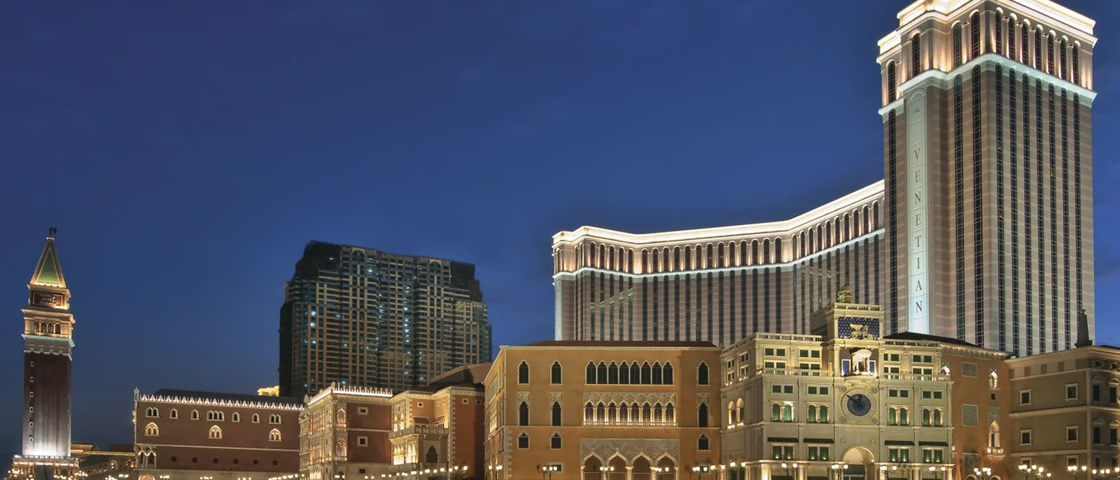
When you hear “the Venetian”, your mind might drift to winding canals, gondolas gliding gently under arching bridges, or perhaps a glamorous resort shining under bright lights. But The Venetian is more than just a beautiful name — it is a grand vision realized in multiple places, each one blending fantasy, luxury, architecture, and spectacle. In this article, we will explore what “The Venetian” means in its different incarnations, where it came from, how it works, and why it captures the imagination of travelers, architects, and dreamers alike.
Introduction: What Is “The Venetian”?
In casual conversation, the phrase “the Venetian” can refer to a few different things, depending on context. Most often, people mean:
- The Venetian Las Vegas — a luxury hotel, casino, and resort on the Las Vegas Strip.
- The Venetian Macao — a resort and casino complex in Macau, China, modeled after its Las Vegas counterpart.
Because the name is shared, there is often confusion — which “Venetian” is meant? But they share a design philosophy, a thematic inspiration (the city of Venice, Italy), and a spirit of extravagance.
In this introduction, I’ll use The Venetian broadly to include both the Las Vegas and Macao properties, while noting their differences as needed. In the first paragraph I have placed the primary keyword “the Venetian”. Later, you will also see it used again as a subheading in a detailed section.
Let’s begin by tracing its roots and inspiration.
Historical and Thematic Roots
Venice, Italy: The Inspiration
To understand the Venetian, we must start with Venice, the floating city full of canals, bridges, piazzas, and baroque architecture. For centuries, Venice has held a romantic appeal in art, literature, and culture. It is a city of water and stone, of gondolas and masked carnivals — and for many it represents the height of elegance, mystery, and timeless beauty.
Designers and developers behind The Venetian sought to capture a fragment of that magic. They borrowed elements such as:
- Grand canals with gondola rides
- Venetian-style facades and architectural motifs
- Indoor piazzas and promenades
- Ornate details, frescoes, sculptures
Thus each “Venetian” transforms the idea of a Venetian neighborhood or palazzo into a modern resort fantasy.
Origins and Vision
The first major Venetian resort was The Venetian Las Vegas. Its development was driven by a vision: to create not just a hotel and casino, but an immersive world in which visitors feel transported to Venice, while enjoying modern luxury.
Later, after the success in Las Vegas, the concept was expanded into Asia via The Venetian Macao. There, the idea was adapted to local and regional expectations — more space, more gaming, more entertainment — but still grounded in the same fantasy that the name evokes.
Thus the Venetian as a brand represents a fusion: Venetian inspiration + modern resort ambition.
The Venetian Las Vegas: A Closer Look
Location, Ownership, and Basics
The Venetian Las Vegas is located on the Las Vegas Strip in Paradise, Nevada. It was developed by Sheldon Adelson through his company, Las Vegas Sands, on the site that once housed the Sands Hotel & Casino.
Ownership has since evolved: The Venetian is now owned by Vici Properties and leased to Apollo Global Management, which operates it.
When it first opened in 1999, The Venetian had 3,036 suites in a 35-story tower. In 2003, a 12-story tower (Venezia tower) was added, bringing total rooms to 4,049. Combined with its sister property The Palazzo, the whole complex rivals the largest hotels in the world (around 7,100 rooms) depending on how you count them.
The resort was designed by architects Stubbins Associates along with Wimberly Allison Tong & Goo.
Design and Attractions
The design of The Venetian Las Vegas is elaborate and carefully constructed to sustain themes. Some of its key attractions:
- Grand Canal Shoppes: A shopping area built to mimic Venetian canals, lined with shops, cafes, and indoor waterways.
- Gondola Rides: Indoor (and outdoor) gondola rides through canals, with gondoliers singing, to heighten the illusion of being in Venice.
- Casino: A large gaming floor offering slots, tables, and high-roller rooms.
- Convention and Event Space: The property includes meeting and convention areas, including Venetian Expo.
- Performance Venues: Over the years, it has hosted shows like Blue Man Group and theatrical productions.
Guest Experience and Amenities
Staying at The Venetian Las Vegas is not simply about the room — it’s about immersion. Some features that enhance the guest experience:
- Suites substantially larger than the typical Las Vegas hotel room.
- Multiple dining options (over 20 restaurants), ranging from casual to high-end.
- Four outdoor pools, a full-service spa, fitness center, and luxury retail.
- Convenient access to Las Vegas transportation networks and proximity to the Strip.
Challenges and Criticisms
Like any major resort, The Venetian has faced challenges:
- Labor relations: At its opening, there were conflicts with culinary workers over union status.
- Construction disputes: Some subcontractors filed liens related to unpaid work.
- Authenticity vs spectacle: Some critics argue that replicating Venice in the desert is kitschy or superficial.
Still, the resort remains a landmark and a go-to destination on the Vegas Strip.
The Venetian Macao: Asia’s Grand Illusion
Location, Scale, and Ownership
The Venetian Macao is situated on the Cotai Strip in Macau, China. It is owned by Las Vegas Sands (Sands China).
In terms of sheer scale, The Venetian Macao is immense:
- It has 3,000 suites.
- A total floor area of about 10,500,000 ft².
- The casino space covers roughly 550,000 ft².
- There is 1,200,000 ft² of convention space and 1,600,000 ft² of retail space.
- The property includes the Cotai Arena with over 14,000 seating capacity for concerts, sports, and shows.
It is often claimed to be the largest casino in the world, and it is the largest single-structure hotel building in Asia.
Design, Inspiration, and Implementation
Just like the Vegas version, The Venetian Macao leans heavily on Venetian motifs:
- Intricate facades, Venetian archways, canals, interior promenades
- Recreated gondola rides
- Lavish interiors, frescoes, marble, decorative elements
But in Macao, designers also had to scale everything up to meet expectations of the Asian gaming market, plus integrate infrastructure and local regulatory requirements.
Notable Features and Attractions
- Gaming: The casino is subdivided into themed zones — Golden Fish, Imperial House, Red Dragon, Phoenix — with thousands of slot machines and hundreds of tables.
- Convention and Retail: Huge mixed-use space for conferences, shopping, exhibitions.
- Venetian Arena: Hosts concerts, sports, and major events.
- Transportation & Access: It is accessible via Macau’s Light Rapid Transit and private resort buses.
- Cultural and Entertainment Programming: Regular performances, exhibitions, and special events keep it fresh for visitors.
Controversies and Challenges
Operating such a large integrated resort in Macau has not been without controversy:
- Labor matters: During the construction phase, there was an incident where thousands of workers were suddenly laid off, leading to public uproar.
- Legal scrutiny: The parent company faced investigations over compliance matters in Macau.
- Social & regulatory pressures: Macau’s gambling regulation and ties with mainland China create constant challenges.
Despite this, The Venetian Macao has dominated the resort landscape in Macau and has been a driving force in making Cotai a global entertainment hub.
The Venetian as a Brand Identity
When we talk about The Venetian as a concept or brand, a few key features emerge. This is not just about two resorts — it’s about what they represent.
Thematic Immersion
A visitor to The Venetian expects more than a hotel room — they expect to step into a different place. The design demands that you suspend disbelief:
- You walk through indoor canals and see gondolas.
- You stroll piazza-style walkways, bridges, and facades.
- The architecture, interior design, art, and lighting are all designed to sustain the theme.
This level of immersion is a signature: the Venetian is not “a hotel with a Venice motif,” it is a “Venetian world.”
Scale and Ambition
Both resorts are enormous. They push limits in terms of:
- Number of rooms
- Retail and convention space
- Casino floor size
- Event venues
They are not boutique escapes — they’re sprawling, city-within-a-resort projects.
Integration of Functions
In The Venetian properties, you don’t just sleep and gamble — you:
- Shop in luxury boutiques
- Dine at casual and fine dining venues
- Attend concerts, shows, and sports
- Do business in conventions and meetings
- Enjoy entertainment exhibitions
They function as “integrated resorts” — combining hospitality, gaming, retail, and entertainment under one roof.
Comparing Las Vegas vs Macao Venetian
| Feature | The Venetian Las Vegas | The Venetian Macao |
|---|---|---|
| Year Opened | 1999 | 2007 |
| Number of Rooms / Suites | ~4,049 | 3,000 |
| Casino Size | ~120,000 sq ft | ~550,000 sq ft |
| Retail / Convention | Large, but smaller scale | Extremely large |
| Entertainment Venues | Theaters, shows | Venetian Arena (14,000+) |
| Local Context | Part of the Vegas Strip | Dominant in Macau’s gaming hub |
In essence: in Las Vegas, The Venetian is a major landmark among many; in Macao, it is the benchmark for integrated resorts in the region.
Subheading: The Venetian — Behind the Scenes
Operational Challenges
Running the Venetian involves handling:
- Guest services and room operations
- Casino compliance and security
- Retail and tenant management
- Events and performance logistics
- Housekeeping and canal maintenance
- Food and beverage coordination
Staff & Training
Staff training is essential:
- Gondoliers must sing and entertain.
- Guest services must deliver high-end hospitality.
- Technicians maintain specialized systems.
- Security ensures both safety and legal compliance.
Sustainability & Maintenance
- Water in canals requires constant care.
- Lighting and HVAC systems are immense.
- Decorative features need restoration.
- Eco-conscious retrofits are increasingly important.
Visitor Experience: Tips and Highlights
Best Time to Visit
- Las Vegas: mornings and evenings are cooler for outdoor walks.
- Macao: check schedules for concerts and exhibitions.
Must-See Experiences
- Gondola rides through canals
- Walks along Venetian-style promenades
- Luxury shopping and dining
- Shows, concerts, and sports
- Themed casinos and arenas
Challenges Ahead and Future Outlook
- Market volatility: Gambling depends on regulation and economic cycles.
- Technology: Guests expect mobile check-in, smart rooms, and modern connectivity.
- Sustainability: Energy and water use will be under pressure.
- Renovations: Regular updates to restaurants, shops, and attractions keep the resorts competitive.
Conclusion: The Future of The Venetian
From the canals of Venice to the deserts of Nevada, to the vibrant casinos of Macau, “the Venetian” embodies a dream: the ability to reimagine place. It is not just an architectural venture, but a psychological one — convincing people they have entered a fantasy.
The Venetian Las Vegas and The Venetian Macao stand as two of the most ambitious, lavish, and immersive resorts ever built. They demonstrate how hospitality, gaming, retail, and entertainment can merge into unified spectacles.